
Gold Making in WoW Forever
Sell, craft or keep: compare proceeds before committing your materials.
 By HarenilPublished
TL;DR
Check the vendor sell value, compare current auction listings, and count a player sale only when the gold arrives. Keep materials you need; crafted common and uncommon wands now vendor for just 1 copper.
- Vendor baselineCopper Ore sells for 5 copper per item in client build 1.60.1.70205, checked October 3. This is a vendor sell value, not an auction price.
- Old wand flipsAll crafted common and uncommon wands now sell to vendors for 1 copper under the October 1 beta notes.
On This Page
Decide What to Do With a Stack
Start with an item you already have. Use its tooltip and your current auction window to decide which option is worth your gold, bag space and attention.
| Your situation | Practical decision | What to check |
|---|---|---|
| You need the material for a known recipe | Keep that quantity; compare only the surplus | Recipe reagents, output count and the cost of replacing the material |
| You want gold now | Compare the vendor offer with a player sale you can actually complete | Net proceeds, time to find a buyer and any posting costs |
| Listings are above vendor value | Consider a small listing before committing the whole stock | Unit price, competing quantity, duration and the gold received after sale |
| A crafted item appears profitable | Price the inputs before crafting a batch | What those inputs could sell for, purchased reagents and the actual output |
| You cannot establish a price or a use | Keep a limited sample if bag space allows | A dated listing check or a recipe that explains the demand |
For training costs, spending priorities and gathering while you quest, use gold while leveling. This guide focuses on evaluating a sale or craft after you have something to trade.
A Dated Copper Ore Listing
In Frostadamus's video uploaded September 29, the Copper Ore search at 5:18 shows a lowest visible unit asking price of 1 silver 9 copper, with 20 at that price. The ruleset and recording date are not identified in the frame. We inspected the retained capture on October 3; it records listings, not completed sales.Reported, press or datamine, not confirmedSource: Frostadamus's beta video, uploaded September 29, 2026; retained frame captured September 30, reviewed October 3, 2026.
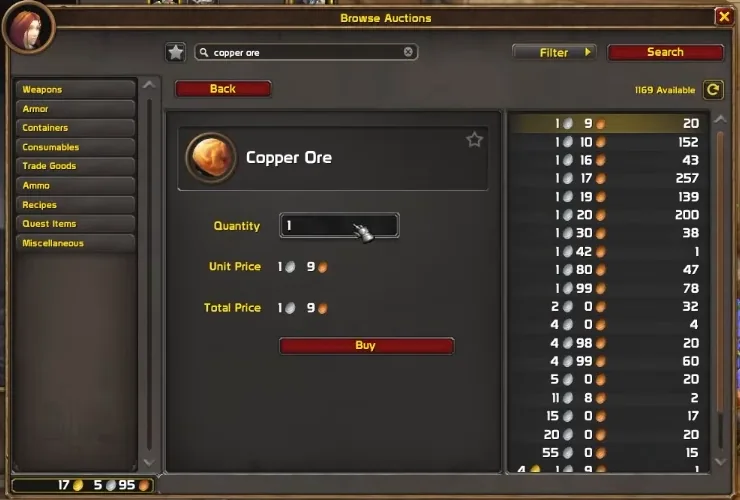
Twenty ore at that unit price would have a gross asking total of 21 silver 80 copper. The current client vendor value for twenty ore is 1 silver. That difference makes checking your own auction window worthwhile; it does not establish a profit, a buyer or today's price. Listing costs, acquisition costs and unsold stock still matter.

The observations here are a small historical sample. They cannot establish a repeatable farm, gold per hour or launch prices. Use a new dated check for a new decision, and keep asking prices separate from completed sales.
Vendor Values You Can Compare
These are per-item vendor sell values, read from beta client 1.60.1.70205 and checked October 3, 2026. They describe client records; check the live item's sell tooltip before committing a sale. They do not establish vendor stock, access or an auction price.
| Item | Vendor sell value per item | Value of 20 items |
|---|---|---|
| Copper Ore | 5 copper | 1 silver |
| Linen Cloth | 13 copper | 2 silver 60 copper |
| Light Leather | 15 copper | 3 silver |
| Bolt of Linen Cloth | 40 copper | 8 silver |
| Pristine Leather | 1 silver 25 copper | 25 silver |
A vendor sell value is a comparison point for an item you could sell. It is not what a vendor charges you to buy it. A scarce material's higher sell value also does not prove that gathering it is faster or more profitable than another activity.
Before selling equipment, check whether you want its appearance. Blizzard's October 1 notes say selling a BoE item with an uncollected appearance to a vendor now makes it soulbound. Do not plan to sell it to another player after that step.Source: Blizzard beta notes, Items, published October 1 and checked October 3, 2026.
Compare a Craft With Selling Its Inputs
Materials you gathered still have an alternative use: you could keep them or sell them. When comparing a craft with a raw-material sale, include that alternative in your decision. When recording a session's cash spending, record the gold you actually paid. Those are different calculations.
Use the recipe's current reagent list and output count. Add bought reagents and the costs of selling the output. Then compare the output's expected net proceeds with the net proceeds you would give up by selling the inputs. If you are crafting for skill or your own gear, record that benefit separately from sale income.
Skip the old wand-to-vendor strategy. Blizzard reduced the vendor sell value of all crafted common and uncommon wands to 1 copper on October 1. The current client also lists Lesser Magic Wand at 1 copper. Crafting a wand can serve a skill or equipment goal; an older silver-value tooltip is not a current vendor-profit calculation.Source: Blizzard beta notes, Professions; current client 1.60.1.70205 item 11287; checked October 3, 2026.
The Enchanting guide explains its crafts, while Tailoring, Alchemy and Leatherworking help identify material uses. Check the recipe you intend to make rather than assuming every material will have a buyer.
Choose a Gathering Session
Choose materials that fit your character's profession and a route you can already reach. The Mining, Herbalism, Skinning and Fishing guides give profession context; choose between them using your access, intended crafts and current sale checks.
Recheck older gathering advice against the October 1 beta changes: starter areas have fewer Poor Copper Vein nodes, and each creature can be skinned only once before it disappears. Those changes affect whether an older session can be repeated as described.Source: Blizzard beta notes, Mining and Skinning, checked October 3, 2026.
For your first session, record where you went, the time spent and what you brought back. Try selling a manageable quantity and wait for the outcome before increasing the session's size. A bag full of materials is inventory; it becomes sale income only after a sale.
Check a Listing Before You Commit
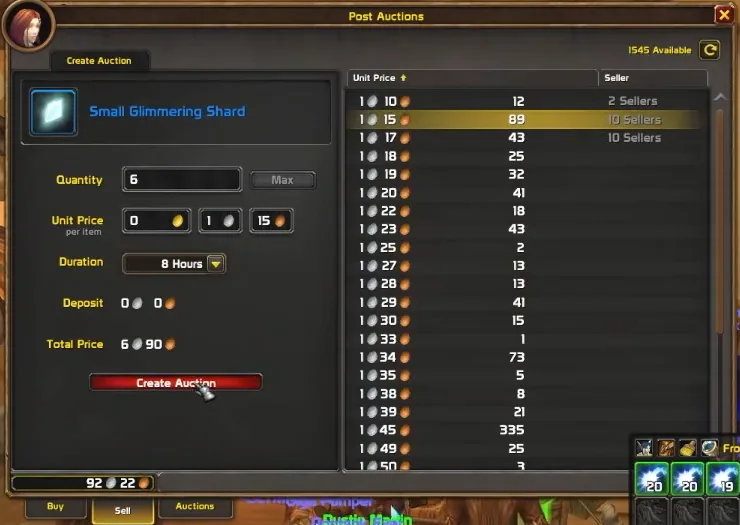
The retained 7:52 frame shows a Small Glimmering Shard posting form: quantity 6, unit asking price 1 silver 15 copper, duration 8 hours, displayed deposit 0, and gross asking total 6 silver 90 copper. These are the fields shown in that September video, not today's shard price or a universal zero-deposit rule.Reported, press or datamine, not confirmedSource: Frostadamus's beta video, uploaded September 29, 2026; retained frame captured September 30, reviewed October 3, 2026.
Use this checklist for the item you plan to sell:
- Read its vendor sell value and check whether you need it for a recipe or appearance.
- Search the exact item. For equipment, compare the same suffix; Blizzard fixed auction suffix display in the October 1 beta update.
- Compare unit prices and the quantities offered at those prices. A stack total alone can mislead.
- Read the deposit and duration for your listing. Avoid repeatedly posting an unsold item without recording the cost.
- After a sale, record the gold actually received. Do not count the asking total or subtract a returned deposit twice.
The suffix fix is documented in Blizzard's User Interface notes.Source: Blizzard beta notes, checked October 3, 2026.
Keep a Small Sale Ledger
A note or spreadsheet is enough. Keep one row per session or batch, then update it when the sale finishes.
| Record | Why it matters |
|---|---|
| Date, build, region and ruleset | Identifies the market and rules you actually checked |
| Route, level, profession and time spent | Makes two of your sessions comparable |
| Item ID, quantity and vendor sell value | Separates the item from similarly named goods |
| Asking price, posting duration and deposits | Records the listing rather than assuming a sale |
| Purchases, consumed reagents and other session costs | Keeps cash spent visible |
| Completed-sale proceeds and vendor proceeds | Counts money received |
| Unsold, kept or crafted quantities | Prevents inventory from becoming imaginary earnings |
For a cash result, subtract the batch's cash costs from its collected proceeds. If you already owned the inputs, keep their opening quantity in the ledger so you do not mistake selling old inventory for production during the new session. For a craft decision, also compare the alternative value of those inputs. Keep a later sale attached to its original batch.
Trade Within the Game's Rules
Blizzard's October 1 update says it has been taking action against beta botting accounts and accounts that bought or knowingly received illicit gold. Penalties include gold removal, suspension and permanent closure, and enforcement will continue after launch. The post announces a warning for trades with strangers as a forthcoming addition.Source: Blizzard: Actions Taken Against Botting and RMT, Kaivax, October 1, checked October 3, 2026.
Earn materials through play and check the origin of a suspicious gold offer. A trade window or a claimed gift does not make illicit gold safe. See Blizzard's linked RMT support guidance for its policy, and our October 1 report for the announcement.
Every row carries an evidence icon: Confirmed, Planned, Reported, Unverified or Not announced. Hover, focus or tap one for its source. Where sources disagree, both stay on the page. How we verify
Sources
- Wowhead Forever: Copper OreWowhead Forever
- Wowhead Forever: Linen ClothWowhead Forever
- Wowhead Forever: Light LeatherWowhead Forever
- Wowhead Forever: Bolt of Linen ClothWowhead Forever
- Wowhead Forever: Pristine LeatherWowhead Forever
- Wowhead Forever: Lesser Magic WandWowhead Forever
- Blizzard: WoW Forever Beta Development Notes, October 1Blizzard
- Frostadamus: How I Made 50 Gold at Lvl 20 - WoW ForeverFrostadamus
- Blizzard: Actions Taken Against Botting and RMTBlizzard
- Blizzard: RMT support guidanceBlizzard
Reported, press or datamine, not confirmed
Press · Copper Ore, Forever database
Confirmed, a first-party source